
October 8, 2026
The infiltration paradox: Pore-gas pressure controls on early slope failure during rapid hydraulic loading
Our paper on the role of pore-gas pressure in rapidly loaded slopes has been accepted for publication in Engineering Geology. The work was carried out with former colleagues at HKUST, Xiaoying Chen and Prof. Jidong Zhao.
Slope stability analyses usually assume that the air in the pores stays at atmospheric pressure. This assumption can break down when water arrives at the surface faster than the ground can respond, as in flash floods or wave overtopping, because the pore-air is then trapped and compressed. Using a three-phase hydro-mechanical material point method that couples large deformation with water–gas flow, we compared a fully gas-coupled model against a reference model in which the pore-gas pressure is held at atmospheric levels.
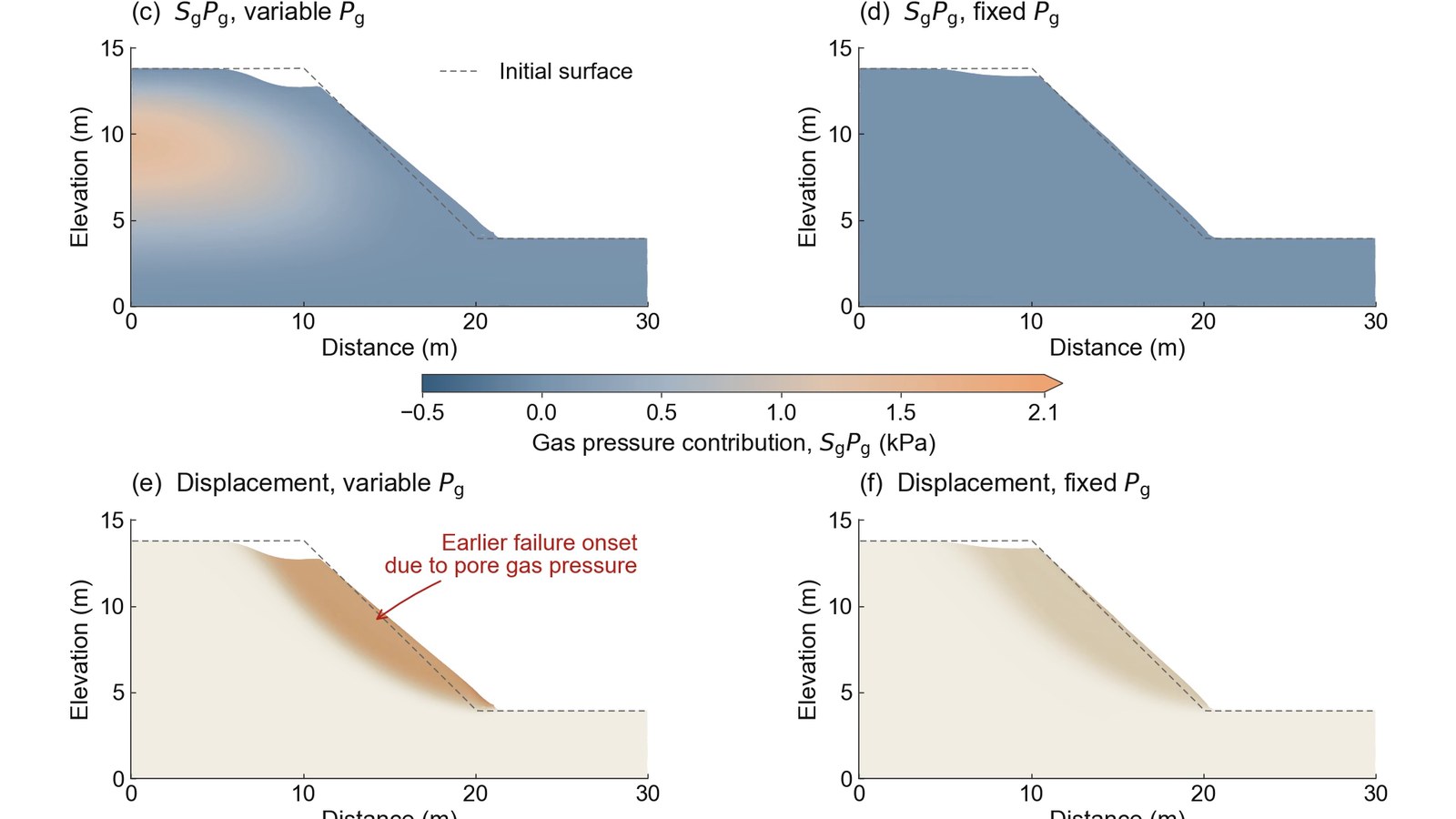
Under weak loading the two models predict similar failure times. Under strong loading, however, resolving the gas pressure leads to progressively earlier instability, by about 6 s at a surface head of 2.5 m. This happens even though gas coupling slows the wetting front and keeps it shallower, a counterintuitive result we call the “infiltration paradox”. Compressed gas raises the mixture pressure inside the developing shear band and pushes the effective stress path toward earlier localization.
MPM simulation of a slope under a 2.5 m surface head with restricted venting: with evolving pore-gas pressure (left) the slope fails earlier than when the gas pressure is held fixed (right).
Chen X.Y., Zhao J.D.*, Yu J.D. (2026). Engineering Geology, 109124. Link